Authors: Mr B. Zondo and Dr M. Lubinga, Agricultural Economists at the National Agricultural Marketing Council (NAMC)
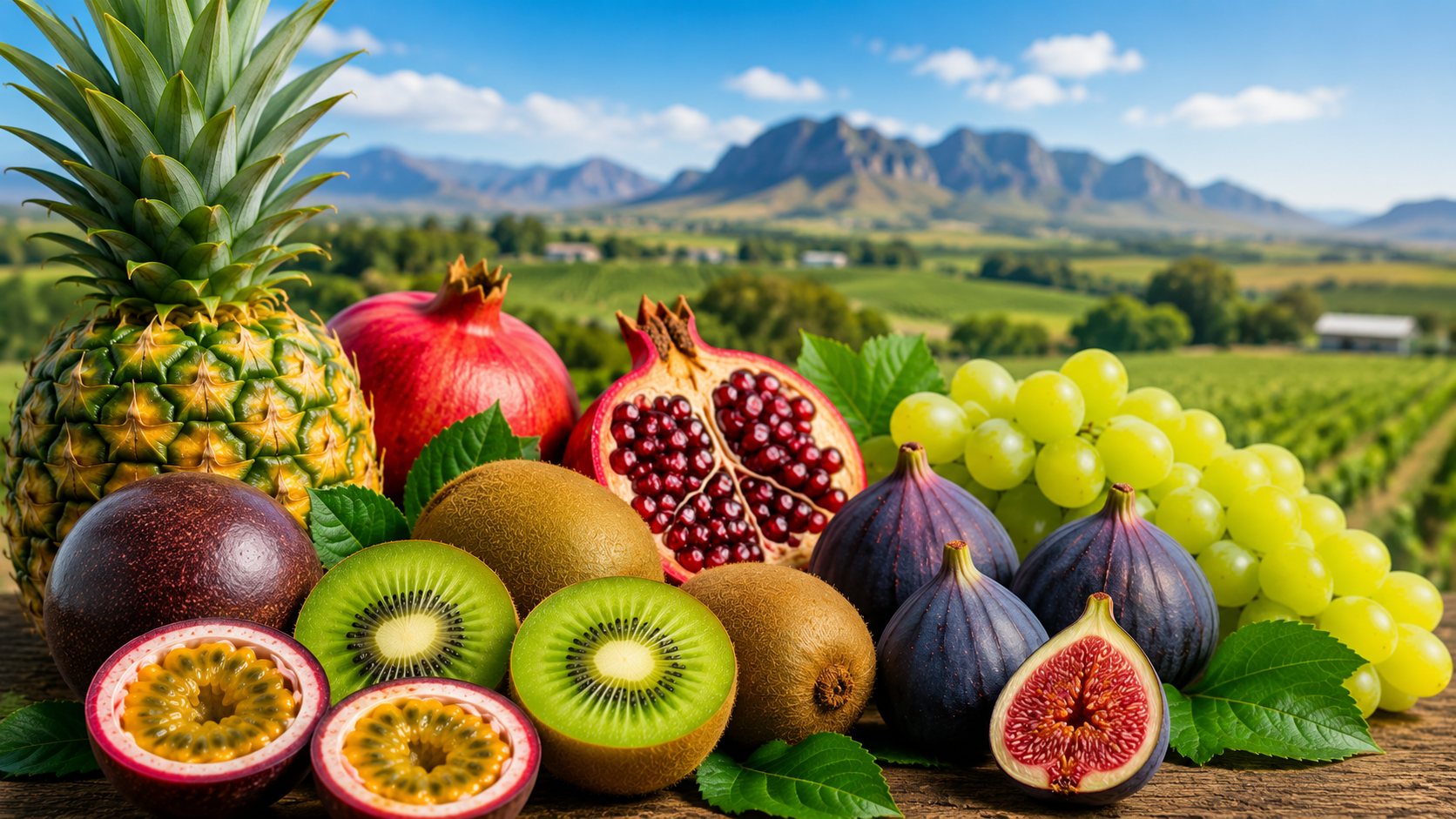
South Africa’s fruit industry is internationally recognized for its competitive performance in the export of citrus, grapes, apples, pears, and subtropical products. In the Southern Hemisphere, South Africa is the largest fruit exporter, accounting for approximately 36% of the region’s total fruit exports. South Africa’s next phase of horticultural growth and competitiveness resides in the latent potential of niche crops. Niche fruits, including kiwi fruit, pineapples, passion fruit, figs, and pomegranates, represent a strategic but underdeveloped segment of the agricultural economy. Although these crops account for relatively lower proportions of fruit production and export volumes, their contribution lies in (i) market diversification, (ii) premium-price positioning, (iii) counter-seasonal supply, and (iv) the potential to strengthen South Africa’s participation in high-value international markets such as the European Union (EU).
The evidence from a recent study by the National Agricultural Marketing Council (NAMC) on the competitive performance identified niche fruits (kiwi fruit, pineapples, passion fruit, figs, and pomegranates) indicates that these niche fruits are no longer peripheral to South Africa’s horticultural development agenda. Their relevance is reinforced by the changing consumer demand in markets such as the EU, where consumers increasingly value health attributes, sustainability, quality and taste attributes, and reliable off-season availability. In terms of counter-seasonality, South Africa’s production window provides a clear market advantage; nevertheless, this advantage will only translate into sustainable competitiveness if it is supported by scale, capability to comply with international market standards, market intelligence, and coordinated investment across the value chain.
The competitive performance of the five selected fruits reflects both opportunity and constraint. Pineapples remain the most commercially established crop in the group. In 2024, South Africa produced approximately 127 102 tons of pineapples, generating an estimated gross production value of R525.6 million. Production increased by about 32% between 2015 and 2024, while gross production value rose by approximately 136% over the same period. By contrast, kiwi fruit, passion fruit, figs, and pomegranates operate as smaller or more specialized industries. However, their strategic value does not lie primarily in bulk supply, but in their ability to serve premium market segments where quality, seasonality, and compliance are more important than volume alone.
Domestic market data further illustrates this differentiated structure. In 2024, the selected niche fruits traded through fresh produce markets generated approximately R287.34 million from 21 969.6 tons, at an average price of about R13 078 per ton. Pineapples dominated the domestic market, accounting for approximately 78% of total revenue and 94% of the traded volumes. However, kiwi fruit, pomegranates, and figs commanded higher average prices per ton, suggesting that they are premium products among consumers. Geographically the sales of the selected fruits were concentrated, with Johannesburg, Tshwane, Cape Town, and Durban accounting for about 93% of total revenue and volumes sold, probably due to higher per capita income of the Provinces the Fresh Produce Markets are based. This concentration suggests that the immediate domestic opportunity lies in strengthening supply to large urban markets while gradually expanding access to smaller markets and export-linked channels.
At the export level, the EU remains an attractive but demanding export destination. Whereas the preferential access under the EU–Southern African Development Community (SADC) Economic Partnership Agreement (EPA) may reduce tariff-related constraints, contemporary market access is increasingly driven by non-tariff requirements. For instance, sanitary and phytosanitary measures, maximum residue limits, traceability systems, private certification, retailer-specific protocols, sustainability requirements, and cold-chain performance have become decisive determinants and drivers of competitiveness. In practical terms, access to premium EU markets is not secured by tariff preferences alone but through the consistent ability to meet compliance standards.
South Africa’s niche fruit export performance to the EU remains uneven. Kiwi fruit exports to the EU drastically increased from about US$3 000 in 2015 to approximately US$3.5 million in 2024, while pineapple exports also increased from about US$912 000 to US$2.05 million over the same period. However, between 2020 and 2024, exports of figs remained modest, declining to approximately US$184 000 from US$373 000, while passion fruit and pomegranate export volumes to the EU declined by about 46% and 94%, respectively. These figures suggest that South Africa’s competitiveness is crop-specific and fragile, with growth in some fruits offset by contraction or underperformance in others.
In terms of export destinations within the EU, in 2024, approximately 82% of South Africa’s kiwi fruit exports were destined for the Netherlands, while pineapples mainly went to Germany (49%), followed by the Netherlands (30%), and France (21%). Figs were exported primarily to the Netherlands, accounting for 48% of the total value of exports, followed by France (30%), and Germany (16%). For passion fruit, Germany accounted for about 87% of value of exports destined for the EU, while pomegranates were concentrated in the Netherlands, commanding 44%, followed by Germany (30%), and Spain (22%) in value terms. In conclusion, South Africa’s niche fruits should be treated as strategic value chains rather than secondary minor crops. Consistent social compact approach that anchors the Agriculture and Agro-processing Master Plan (AAMP), the development of the respective value chains requires deliberate coordination among producers, exporters, various government departments, industry bodies, researchers and finance institutions, as well as other development partners. Priority interventions should include cultivar development, establishment of climate-smart production systems, residue monitoring, certification support, cold-chain investment, market intelligence, direct buyer engagement, and accelerated registration of EU-compliant agrochemicals. These interventions are particularly important for small-holder producers, who face disproportionately high compliance and market-access-related costs.