Featured
China’s zero-tariff policy: Implications for the Republic of South Africa’s agricultural sector
China’s proposed zero-tariff policy reflects strong optimism about market-access opportunities for South Africa’s agricultural sector amid rising protectionism and uncertainty in international trade. In 2025, China’s merchandise imports reached US$2.58 trillion, accounting for 10% of world imports, while South Africa’s global merchandise exports stood at US$116.7 billion. Both recorded average annual declines of 1% and 2%, respectively, between 2021 and 2025. South Africa’s exports to China totalled US$12.79 billion, representing 11% of total merchandise exports, despite contracting 1% annually over the same period. Within agriculture, South Africa exported US$697.6 million to China, against China’s global agricultural imports of US$187.5 billion, compared with South Africa’s total agricultural exports of US$15.11 billion. The proposed scheme offers qualifying products duty-free access beyond 2028, subject to rules of origin and tariff-rate quotas on 47 tariff lines. Between June and August 2026, SARS issued 25,975 certificates of origin, while customs declarations increased by 199%. Alongside negotiations towards a SACU–China Early Harvest Arrangement, these developments create space to aggressively strengthen preferential market access, agricultural export competitiveness, domestic processing, and employment.
South Africa’s agricultural exports to China totalled US$697.6 million in 2025, down from about US$731.4 million in 2024. China accounted for 4.62% of South Africa’s US$15.1 billion in global agricultural exports, indicating a relatively modest contribution to export earnings. The principal agricultural products exported to China include fresh and dried nuts, greasy shorn wool, in-shell and shelled macadamia nuts, oranges, mandarins, tangerines and satsumas, fresh apples, grapefruit and pomelos, raw bovine hides, sheep and lamb skins, and wine. Several products have recorded growth despite existing tariffs. Between 2021 and 2025, exports of fresh and dried nuts increased by 23% per annum, while shelled macadamia nuts grew by 25% per annum, despite both products facing ad valorem tariffs of 24%. Pear exports recorded annual value growth of 344% over the same period, notwithstanding an 11% tariff. These developments suggest that South African exporters have established a competitive presence in selected product markets, inspiring confidence that tariff elimination may drive further growth.
South Africa’s agricultural imports from China totalled US$501 million in 2025, down from US$502 million in 2024. The principal imports included apple juice; animal guts, bladders and stomachs (excluding fish); peptones and their derivatives; dried vegetables and vegetable mixtures; malt (excluding roasted malt); preparations used in animal feeding; prepared or preserved tomatoes; fruits of the Capsicum and Pimenta genera; solid glucose and glucose syrup; and sugar confectionery not containing cocoa. Notably, malt imports from China rose by 233% per annum between 2021 and 2025, indicating rapid growth from a small initial trade base. Consequently, South Africa recorded an agricultural trade surplus of about US$196 million with China in 2025, reflecting a bilateral relationship in which agricultural export earnings continue to exceed import expenditure.
China remains one of the world’s largest agricultural import markets, although its import demand has weakened in recent years. Agricultural imports from the world declined from US$197.2 billion in 2024 to US$187.5 billion in 2025, about 12.4 times South Africa’s total agricultural exports. China’s leading agricultural imports include soybeans, frozen boneless beef, fresh durians, food preparations, palm oil and its fractions, fresh cherries (excluding sour cherries), fish and crustacean flours, meals and pellets, barley, frozen edible swine offal, low-erucic-acid rape or colza oil, and raw cane sugar. The composition of these imports provides a basis for identifying potential export opportunities, particularly in products where South Africa has established or emerging supply capacity such as cherries.
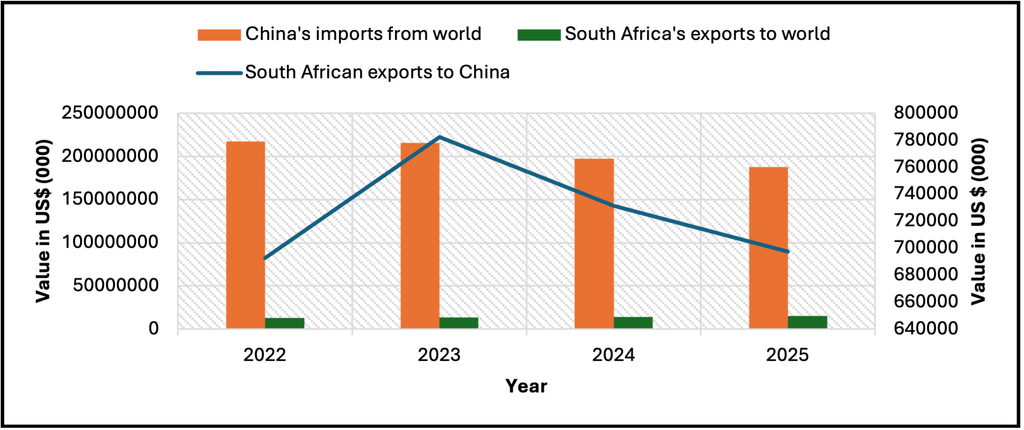
Source: NAMC calculations based on ITC data
Figure 1 shows that China remains a substantial yet underutilised market for South African agricultural exports. Between 2022 and 2025, China’s agricultural imports fell 13.6%, from US$217.2 billion to US$187.5 billion, while South Africa’s global agricultural exports rose 17.5% to US$15.1 billion. However, exports to China remained largely unchanged at about US$698 million, down 10.9% from the 2023 peak of US$783 million. Although South Africa’s share of China’s agricultural imports rose marginally from 0.32% to 0.37%, China’s share of South Africa’s agricultural export earnings fell from 5.4% to 4.6%. China’s proposed zero-tariff arrangement, alongside SACU–China Early Harvest negotiations, could strengthen preferential market access beyond 2028. Tariff elimination is a positive step towards market access in China, but more is needed to ensure a sustainable presence and market penetration. Key next steps must include addressing sanitary and phytosanitary requirements, logistical constraints, and limited product diversification, while promoting domestic agro-processing, investment, and employment.